Best Robot Vacuum for Pet Hair (2026): Three Picks for Daily Fur
A robot vacuum can keep daily fur under control, but brush design, navigation, and dock maintenance matter more than a huge suction number.
By Nate Brooks
Pawsidepicks is reader-supported. As an Amazon Associate we earn from qualifying purchases. Learn more.
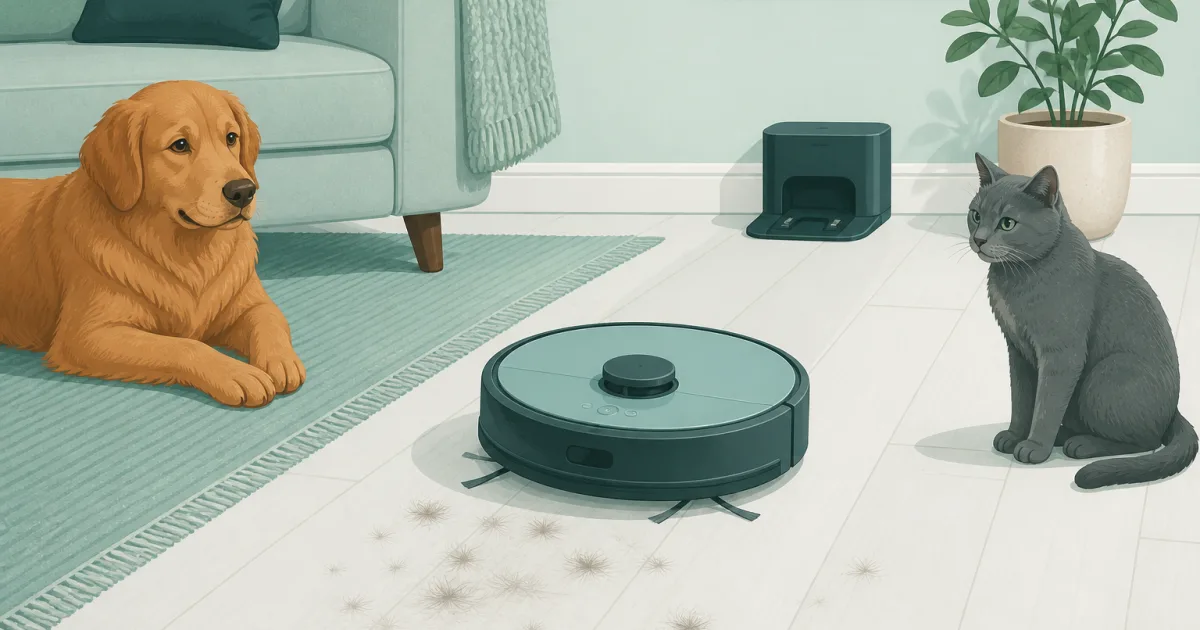
The short answer: The Shark AV2501S AI Ultra is the best robot vacuum for pet hair for most homes because its self-cleaning brushroll, HEPA bagless base, and room mapping cover the useful basics. Pick the roborock Q7 Max+ for better mixed-floor controls, or the Roomba j7+ when avoiding cords and pet accidents matters most.
Our picks
Pet hair is a good reason to buy a robot vacuum, but it is also a hard test. Fur wraps around rollers, fills small bins, and collects along rug edges. A robot that runs every day can keep those loose tumbleweeds from forming. It will not replace a full-size vacuum for deep carpet, stairs, furniture, or the gap behind the sofa.
We compared live US Amazon listings, current specifications, ratings, and detailed buyer feedback. We have not lab-tested these vacuums. All three picks cleared our 4.0-star floor and have thousands of reviews that discuss real homes, pets, mapping, brush maintenance, docks, and long-term use.
Compare our robot vacuum picks for pet hair
Start with your floor plan. A simple home with open hard floors does not need the fanciest avoidance system. A busy home with charging cords, dog toys, and occasional accidents benefits from a robot that can identify objects. Thick rugs and long hair demand more brush maintenance no matter which model you buy.
Best overall: Shark AV2501S AI Ultra
The Shark AV2501S AI Ultra Robot Vacuum is our best overall pick for pet hair because it combines a self-cleaning brushroll with a bagless self-empty base. The base includes HEPA filtration, which is useful when fur comes with fine dust and dander. You can empty the bin without buying disposable dock bags.
The live Amazon listing showed 4.2 stars from more than 44,000 ratings at review check. Helpful owner feedback repeatedly discusses pet-hair pickup, the loud but brief self-empty cycle, and the convenience of scheduled cleaning. Owners also report that long hair can still collect around the ends of the brushroll. “Self-cleaning” means less cutting and pulling, not zero maintenance.
Shark's Matrix Clean mode sends the robot over an area in multiple directions. That can help on high-traffic carpet where fur sits between fibers, though it takes longer and uses more battery. The app supports room maps and targeted cleaning. Give the robot a few clean mapping runs before judging it, and move the dock only if you are willing to rebuild the map.
Choose the Shark when you want a straightforward daily cleaner and prefer a bagless base. Skip it if you are sensitive to dust during emptying or want the strongest object recognition. A bagged dock contains debris better when you remove it, while the Shark bin asks you to tip loose dust into a trash can.
Best for mixed floors: roborock Q7 Max+
The roborock Q7 Max+ Robot Vacuum and Mop suits a home with hard floors, low-pile rugs, and rooms you want to control precisely. LiDAR builds a map quickly and does not need a brightly lit room. You can set no-go zones, no-mop zones, room schedules, and carpet boost in the app.
The Amazon listing showed 4.2 stars from more than 4,700 ratings at review check. Detailed reviews discuss dog and cat fur on hard floors, mapping after furniture changes, dock behavior, and the need to clean the rubber roller. The all-rubber main brush is easier to clear than a dense bristle roll, but hair can still wind around the bearings at each end.
The Q7 Max+ also mops, but treat that as a damp maintenance pass. It does not wash its own pad or lift the mop high enough for every thick rug. Pick up the pad after use, wash it, and let it dry. If you leave a dirty wet pad attached, the robot simply moves yesterday's grime around more efficiently.
Choose the roborock when mapping controls and mixed-floor routines matter more than advanced obstacle recognition. Do a quick floor check before it runs. Small cords, cat toys, and loose fabric can still stop a cleaning job.
Best obstacle avoidance: iRobot Roomba j7+
The iRobot Roomba j7+ Self-Emptying Robot Vacuum is the better fit for a home where clutter is the main reason scheduled cleaning fails. Its front camera is designed to recognize common objects such as cords, socks, shoes, and pet waste. iRobot also advertises a Pet Owner Official Promise for eligible purchases, subject to its current terms.
The live listing showed 4.3 stars from more than 6,200 ratings at review check. Substantive reviews describe homes with multiple dogs, repeated daily schedules, pet-hair volume in the dock bag, obstacle behavior, map editing, and the noise of automatic emptying. Owners like that it gets stuck less often than older random-navigation Roombas, though some report weaker edge pickup and uneven results on heavy carpet fur.
The dual rubber brushes resist tangles better than a single bristle roll. They still need inspection. Pull off the end caps, remove wound hair, and wipe the sensors on a regular schedule. Fur packed behind a roller cap can add drag long before the app tells you something is wrong.
The camera needs usable light to identify objects. If you schedule overnight runs in a dark room, obstacle avoidance may not work as well. The j7+ is also a poor reason to stop checking the floor. Recognition lowers risk; it does not make an unattended pet accident harmless.
What matters most for pet hair
A roller you can actually clean
Marketing often focuses on suction, but hair reaches the roller first. Rubber rollers and self-cleaning brush designs reduce wrapping. Check whether the roller comes out without tools and whether replacement rollers, side brushes, and filters are easy to buy.
Inspect both ends of the roller weekly. Long human hair is often harder on the bearings than short pet fur. Remove hair before it forms a tight ring, then check that the roller spins freely when you reinstall it.
A dock sized for your shedding level
A self-empty base is especially useful with pets because fur quickly fills the robot's small bin. The advertised 30-day or 60-day capacity is an estimate, not a promise. A German shepherd in shedding season can fill a dock much faster than a short-haired cat.
Bagged docks are cleaner to empty and better at containing fine dust. Bagless docks avoid ongoing bag costs but can release a small cloud when dumped. If someone in the home has allergies, empty a bagless base outdoors and follow the filter-cleaning instructions.
Navigation that fits your home
LiDAR maps quickly and works in low light. Camera systems can recognize specific objects but may need room light. Both can struggle with mirrors, black surfaces, low furniture, or a dock squeezed into a poor location.
Give the robot clearance around its base and run the first map with doors open, cords lifted, and pet bowls moved. Add no-go zones around delicate feeding stations, floor vents, and thick rug fringe. A clean first map saves many rescue missions later.
Set up a safer pet-home cleaning routine
Check the floor before each unattended run. Pick up cords, fabric toys, food, water bowls, and anything small enough to fit under the robot. Look for pet accidents even if your model claims to avoid them. One missed mess can turn a useful appliance into a long cleanup.
Run the robot when your pet is calm and supervised at first. Some pets ignore it. Others bark, swat, chase, or block the dock. Do not force a nervous animal to stay in the room. Start with a short targeted clean, reward calm behavior, and provide an easy route away from the machine.
Daily runs usually work better than one long weekly run. The robot collects fur before it mats into carpet or drifts under furniture. Use a regular vacuum weekly for corners, stairs, upholstery, and thick rugs. A pet grooming vacuum can reduce loose coat at the source if your pet accepts the sound and brush.
Keep the robot from becoming a fur box
Empty or inspect the dock before it reaches its claimed maximum interval. Clean the robot's filter, front wheel, side brush, sensors, and roller according to the manual. A packed filter cuts airflow, while hair around the front wheel makes navigation less accurate.
Wash only parts the manufacturer labels washable. Let filters dry completely before reinstalling them. Keep a spare filter and dock bag if your model uses one, but avoid replacing parts on a calendar when a simple inspection shows they are still clean and undamaged.
Clean the charging contacts with a dry cloth. Pet hair and litter dust can settle around the dock and cause poor charging or failed emptying. If the robot suddenly starts stopping early, check the simple maintenance points before deleting maps or resetting the app.
Robot vacuuming also works better as part of a larger routine. Wash pet bedding, brush your pet appropriately, and use a sealed full-size vacuum for deep cleaning. Our best pet air purifier guide covers airborne dander, but a purifier will not collect the fur already sitting on the floor.
Bottom line
Buy the Shark AV2501S AI Ultra if you want a capable daily pet-hair cleaner with a bagless HEPA self-empty base. Choose the roborock Q7 Max+ for strong mapping controls across hard floors and rugs. Pay more for the Roomba j7+ when obstacle recognition is the feature most likely to keep your schedule running.
Whichever one you choose, check the floor, clean the roller, and keep a regular vacuum. A robot is excellent at collecting yesterday's loose fur. It is not a complete cleaning crew.
Frequently Asked Questions
What is the best robot vacuum for pet hair?
The Shark AV2501S AI Ultra is our best overall pick because it combines a self-cleaning brushroll, a HEPA bagless base, and useful room mapping. Choose the Roomba j7+ instead if avoiding floor clutter and pet accidents is your first concern.
Do robot vacuums really pick up dog and cat hair?
Yes, they can collect the loose fur that lands on open floors each day. They work best as maintenance cleaners. You will still need a full-size vacuum for stairs, upholstery, deep carpet, and tight edges.
Are rubber brushes better for pet hair?
Rubber rollers usually hold less wrapped hair than traditional bristle brushes, but no roller is maintenance-free. Check the ends of the roller and remove wound hair every week.
Can a robot vacuum avoid pet poop?
Some camera-equipped models, including the Roomba j7+, are designed to recognize pet waste. No system is perfect. Check the floor before every unattended run, especially with a puppy, senior pet, or sick animal.
How often should I run a robot vacuum with pets?
Start with one run per day in the rooms where your pet spends the most time. Heavy shedding may need two targeted runs. Empty or inspect the base more often than the maximum interval claimed by the manufacturer.
Is a self-emptying robot vacuum worth it for pet hair?
It can be. Fur fills a small onboard bin quickly, so a self-empty dock reduces interruptions. Bagless docks cost less to maintain, while bagged docks usually contain dust better during disposal.
Will a robot vacuum clean pet hair from thick carpet?
It can reduce surface fur, but thick carpet is a difficult job for a small robot. Use a full-size vacuum with a powered brush for embedded hair, then let the robot handle daily upkeep.